Learn Spanish in just 5 minutes a day
The most common words cover 85% of everyday Spanish. You learn them first, and the app has you review each one just before you would forget it.


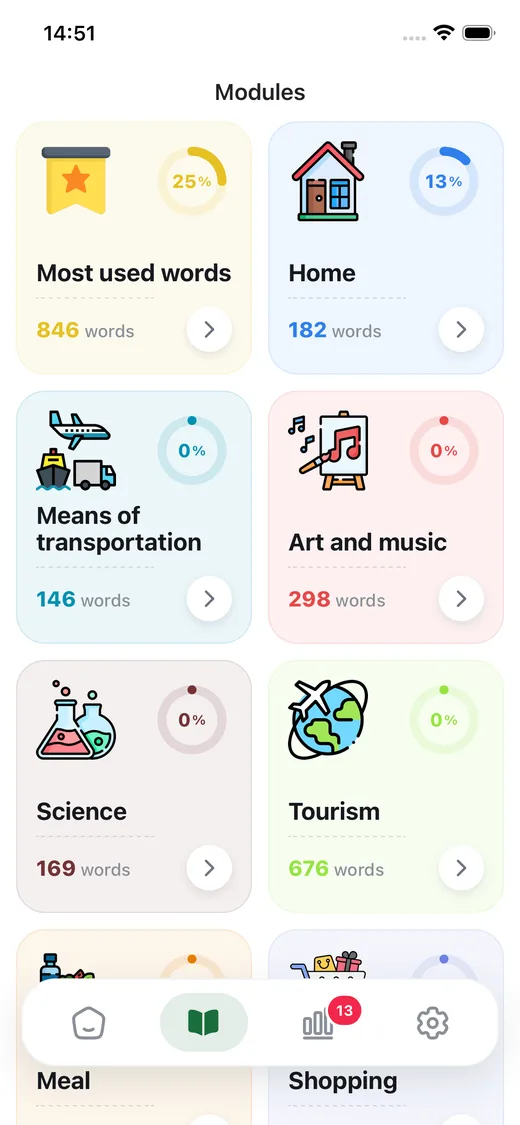
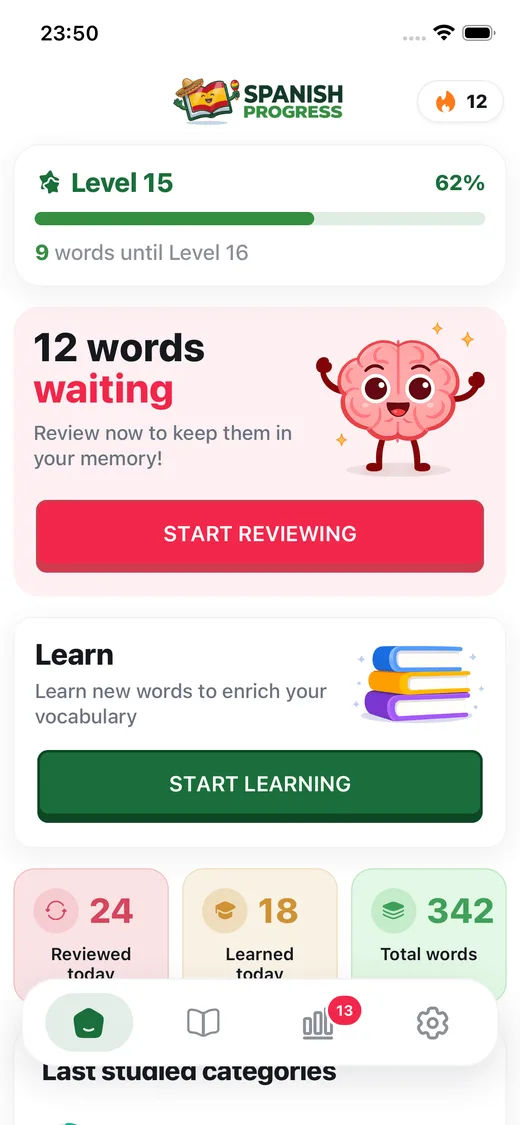
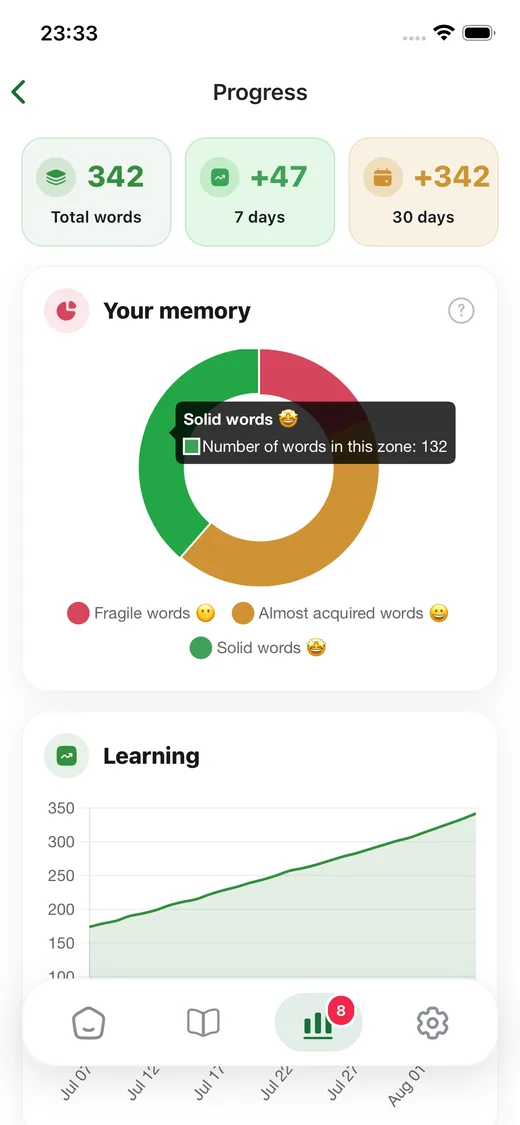
Spanish vocabulary, in frequency order
The words you need to order a meal in Mexico City, or to follow a series without reading the subtitles.
Frequency decides the order
Everyday Spanish is the same in Madrid, Mexico City or Buenos Aires. That shared vocabulary is what you learn, starting with the words that come up in any conversation.
Each word gets the passes it needs
The app works out when each word is about to fade and puts it back that day. A word you keep getting right spaces out further and further; one that keeps slipping returns at short intervals until it sticks.
A coach that sets the pace
The coach sets the intake from your actual speed: it raises the pace while your answers keep landing, and lowers it when the review queue grows.
Learn while having fun
Sessions keep changing shape: flashcards, multiple choice, typing, riddles, matching pairs. Five minutes feel like a game, and since every card carries audio, your ear trains along with your memory.
What a session looks like
Pick your level and topics
You tell the app where you are starting from and what you want Spanish for. A trip through Latin America, a colleague, a series, a move: each one pulls a different set of words to the front.
Learn in 5-minute sessions
About 10 new words per session. Spanish spelling is phonetic, so hearing a card once is usually enough to say the word correctly afterwards.
Review right on time
The app tells you what is due. Right answers push a word further out; the false friends you trip over keep their short interval until they stop tripping you.
Why the timing of a review matters
You forget about 70% of what you learn within 24 hours, and words that have to overwrite an English association fade fastest of all. The schedule matters most exactly there.
Answer correctly and the next review moves further out. Read how spaced repetition works.
Questions we get
The app tracks when each word is likely to fade and puts the review on that day. Intervals grow as you keep getting the word right: 1 day, then 3, 7, 14, 30. Get it wrong and the word comes back sooner.
The FSI estimates around 600 to 750 hours of study for an English speaker to reach professional working proficiency in Spanish. You do not have to wait that long to use the language: daily 5-minute vocabulary sessions with spaced repetition make progress cumulative, so every session builds on the last. See the full timeline.
You can download it and start learning at no cost. A subscription, monthly or yearly, lets you learn and review without limits.
The interface is in English, French, Portuguese, Japanese and Korean. Each word carries its translation and its audio, so you learn Spanish from your own language.
Yes. You start with the words that come up most in daily life, and the exercises get harder as your vocabulary grows. See what each vocabulary tier covers.
Both, in the sense that matters here. The 6,000 most frequent words are shared across Spain and Latin America; the differences sit in a small set of everyday nouns and in how people address each other. Learn the core and you will be understood in Madrid, Mexico City and Buenos Aires. See the 150 words a trip actually needs.
Your first session takes 5 minutes
Download Spanish Progress and start today. Free on iOS and Android.